
Letting Live Composite work
Can I trust Live Composite to show me what’s happening in real time?
This image was a lot of fun to make. The experiment was unplanned and opportunistic. Yesterday morning I’d seen a YouTube video about using “live composite“ mode (often described simply as “live comp”) in the context of coastal landscape photography. The idea of this mode is that the camera takes sequential exposures and overlays the highlights, the light areas. This enables people to for example take pictures of peers and smooth the water out, often without needing to use physical ND filters.
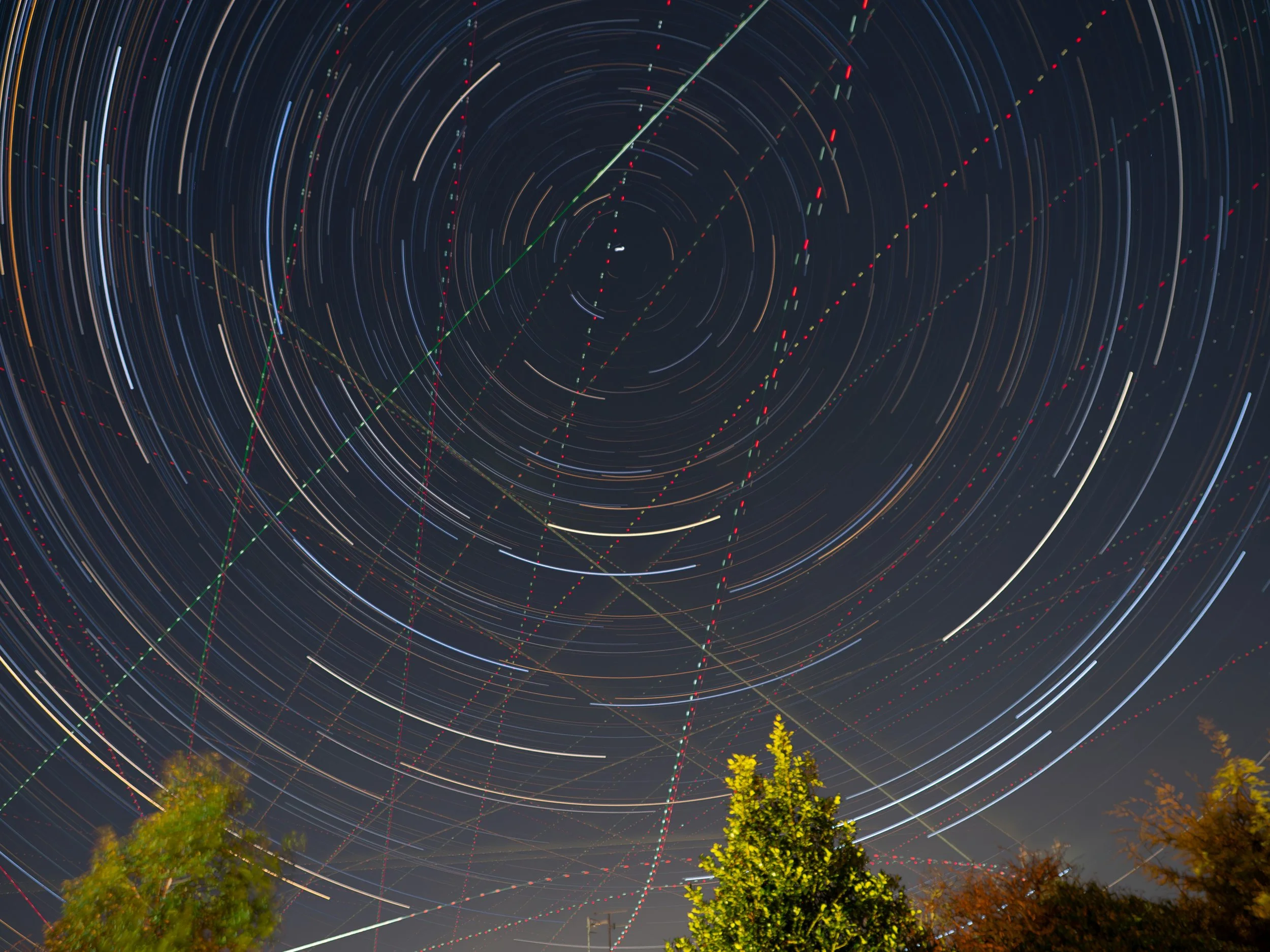
Long-exposure star trail image showing curved arcs of stars circling Polaris above silhouetted trees, with faint aircraft and satellite trails crossing the night sky.
Image composite, sequential 10s exposure at F2.8, over 2 ½ hours.
In the evening, I opened the back door and looked up: there were the stars. I thought back to the video that I’d seen earlier in the day and decided that I would try and get some starlight trails using live comp.
The camera went on the tripod and I started exploring the settings in the camera. With no idea what I was doing, I pointed the camera in the general direction of Polaris and set ISO to 800, aperture at F2.8 with an exposure time of 10 seconds. Looking on the PhotoPills app I had an idea that I would need to leave the camera for at least 40 to 50 minutes to get decent trails. I pressed the shutter button to take the reference frame and followed the instructions on the back of the camera, pressing the shutter button again.
Then I left the camera to it.
I checked back after about half an hour and sure enough the live preview was showing some short lines coming from the stars. There was also a single straight line going across the image which I assumed was an aeroplane. This wasn’t surprising as I only live 30 miles from Gatwick Airport. More time needed…
With an inordinate amount of self-control, I eventually left it running for 2 1/2 hours. The preview on the back of the camera looked promising though I was surprised by the number of straight lines. Uploading it into Lightroom showed me an image which to be honest exceeded my expectations by a considerable amount. I had ended up with a multi layered image: in the distance, the universe demonstrating the rotation of the planet, arcs of different colours sweeping around the focus of Polaris; closer to me, the presence of humanity, the lines across the field of view showing the passage of satellites and aeroplanes. I was also pleasantly surprised to discover that minimal editing was required: a slight bump in contrast, a reduction in blacks and finally applying a bit of noise reduction was all that was necessary.
Is this image technically perfect? No, of course not. I will no doubt try again. Next time though will be with more intent: I will be checking settings suggested by people who do this professionally and will try out the Starry Sky AF setting on the camera too see if I can make those arcs sharper. But I have to say for my first attempt at this kind of photography I was very pleased.
